When America Says “Drink Less” and India Says “Don’t Drink”: Two Countries, One Alcohol Confusion
The US has softened its alcohol advice to “drink less,” while India quietly pushes avoidance. A simple breakdown of what both guidelines really mean for drinkers.
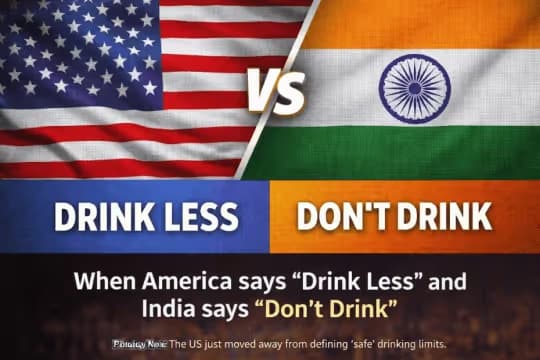
It starts with a sentence that sounds harmless enough.
In early 2025, the United States quietly removed its long-standing alcohol advice. The familiar rule — two drinks a day for men, one for women — disappeared. In its place came something softer, almost polite:
“Consume less alcohol for better overall health.”
No numbers. No limits. Just a suggestion.
Across the world, India has spent decades saying something very different, and yet oddly similar:
“Alcohol is injurious to health.”
Blunt. Final. End of discussion.
And somewhere between those two messages — one vague, one moral — sits the modern drinker, trying to figure out what any of this actually means.
American Shift: When Science Gets Stronger and Advice Gets Softer
In the US, the science around alcohol has only moved in one direction. More links to cancer. Clearer data on liver disease. Stronger evidence that even “moderate” drinking carries risk.
Yet the official advice has moved the other way.
By dropping numeric limits, US policymakers avoided saying when alcohol becomes unsafe. Public-health experts weren’t thrilled. Without numbers, people don’t change behaviour — they rationalise it.
“Drink less” sounds reasonable. It also means everything and nothing at the same time.
For a culture used to counting drinks, the new guidance feels like a step back. The risk is acknowledged, but not explained. Responsibility is shifted to the individual without giving them tools to measure it.
India’s Position: Strong Words, No Map
India looks tougher at first glance.
There is no soft language here. Alcohol is discouraged outright in dietary guidelines. Health documents frame it as something to avoid, not manage.
But here’s the catch: India never really tells drinkers how to drink safely.
Low-risk limits do exist. Medical experts define them. Researchers write about them. But they live deep inside clinical reports, not in public campaigns, labels, or everyday conversation.
Most Indian drinkers have no idea that:
- a “standard drink” in India is 10 grams of alcohol
- daily and weekly limits even exist
- risk depends on pattern, not just quantity
So while India officially says “don’t drink”, reality tells a different story.
Liquor shops are expanding. Premium brands are multiplying. Cocktail culture is booming. Alcohol is everywhere — except in clear public education.
Same Science, Different Silence
Put the two countries side by side, and something strange appears.
The US talks openly about drinking, but avoids clear limits.
India warns loudly about alcohol, but avoids practical guidance.
Both accept the same truth: less alcohol means less harm.
Neither explains what that looks like in real life.
One offers freedom without clarity. The other offers restrictions without instructions.
For drinkers, both approaches fail the same test: what should I actually do tonight?
The Human Cost of Vague Advice
This gap matters more than policymakers admit.
When guidance is unclear:
- People underestimate risk
- “Occasional” becomes frequent
- Marketing fills the education vacuum
In the US, dropping numbers makes it easier to ignore long-term harm.
In India, shouting “avoid” without explanation pushes drinkers to rely on peer advice, myths, and brand messaging.
Neither helps someone decide:
- How many drinks are already too many
- When skipping alcohol matters more than moderation
- Why weekly patterns matter more than weekend bravado
What Both Countries Are Avoiding
Clear alcohol guidance is uncomfortable.
It upsets industries. It angers voters. It forces governments to admit that alcohol is a risk, not a lifestyle enhancer.
So both countries compromise — in opposite directions.
America removes the ruler. India hides it.
The Last Sip
This isn’t about banning alcohol or promoting it.
It’s about honest communication.
As drinking becomes more visible, more aspirational, and more normalised in India — and more medically scrutinised in the US — the need is the same on both sides:
Not moral advice. Not vague warnings. But clear, human, usable information.
Because people are not asking if alcohol is good for them.
They’re asking: How much is too much, how often is too often, and when is zero the only smart choice?
Right now, neither India nor the US is answering that well.
OccasionalDrinker promotes mindful and responsible alcohol consumption. Content intended for adults 21+.